
Hertford Juvenile Program Exits
A youth does not “release” from Hertford County Multipurpose Juvenile Home through the same process used at an adult jail. The home is a non-secure residential program. Placement and exit follow the juvenile court counselor’s work and the program or court plan for that child. An exit may mean a return to a parent or guardian, movement to another approved placement, or another step ordered within the juvenile case. Public research cannot identify which outcome applies to a named youth.
The adult terms “bond,” “time served,” “jail release,” and “prison discharge” do not describe this program’s normal function. The Hertford County Sheriff does not operate it. The North Carolina Department of Adult Correction’s offender database is not its record system. VINELink is not a public youth locator. A missing adult search result therefore says nothing about whether a child entered, remained in, or left this home.
| Information need | Appropriate route |
|---|---|
| Program model and operator | Official state residential contracted-program description |
| Authorized case-specific placement question | Assigned juvenile court counselor or authorized program contact |
| Juvenile court order or case question | Attorney or clerk route permitted for that restricted matter |
| Adult county-jail release | Hertford County Detention Center, not the juvenile home |
| Public youth roster or photograph | Not an available public search product |
Confirm a Hertford Program Exit
Only a person with a proper role in the youth’s case should seek individual placement or exit information. That may include a parent or guardian, the youth’s attorney, the assigned juvenile court counselor, or another person authorized by law or court process. The program can require identity and authority checks before sharing protected information. Public-record methods used for adult jail episodes must not be used to bypass those limits.
- Use the contact already supplied in the youth’s case or placement papers. Start with the assigned juvenile court counselor when that person is known.
- State the caller’s relationship to the youth and be ready to verify identity and legal authority. Do not send private case facts through an unsecured public channel.
- Ask the narrow operational question needed, such as whether an authorized pickup, meeting, or approved transition has been scheduled.
- For a court-order question, work through the youth’s lawyer or the juvenile court channel authorized for the case.
- If access is denied, ask which authorized office can handle the request. Do not seek the same protected details through an adult database.
For an adult custody episode, use the separate Hertford County Detention Center release route. Keeping those channels apart avoids both false matches and improper disclosure.
Hertford Juvenile Records Contact
The research identifies Methodist Home for Children as the operator under state contract, but it does not provide a verified facility street address, direct phone number, or public office hours for case inquiries. Those details should not be guessed or borrowed from an unrelated Methodist Home for Children program. An authorized person should use existing referral or placement paperwork and the assigned juvenile court counselor.
Hertford County Multipurpose Juvenile Home
Hertford County, North Carolina
Non-secure residential contracted program
Operator: Methodist Home for Children
Direct public phone: Not published in the research
Public records hours: Not published
The North Carolina residential contracted-program description is the verified public source for the program model. It supports general information, not disclosure about a named child. If an official contact changes, the state source or current case documents should control over copied directory entries.
Hertford Juvenile Record Profile
State sources describe the Hertford County Multipurpose Juvenile Home as a coed, non-secure residential alternative. It has eight beds and mainly serves court-referred Level II youth, roughly ages 10 through 17. The program is operated under state contract by Methodist Home for Children. Its small residential model is different from a secure detention center, a county jail, or a state adult prison.
These figures describe the public program model. They are not a current occupancy count, and they do not establish that any named youth is present. The source describes stays in months, but no fixed term can be inferred for one child. Length depends on the authorized plan and case-specific decisions. Do not use capacity or age range to reverse-engineer a participant’s identity.
The official program description is shown below only at the program level. It contains no youth identity or case result.
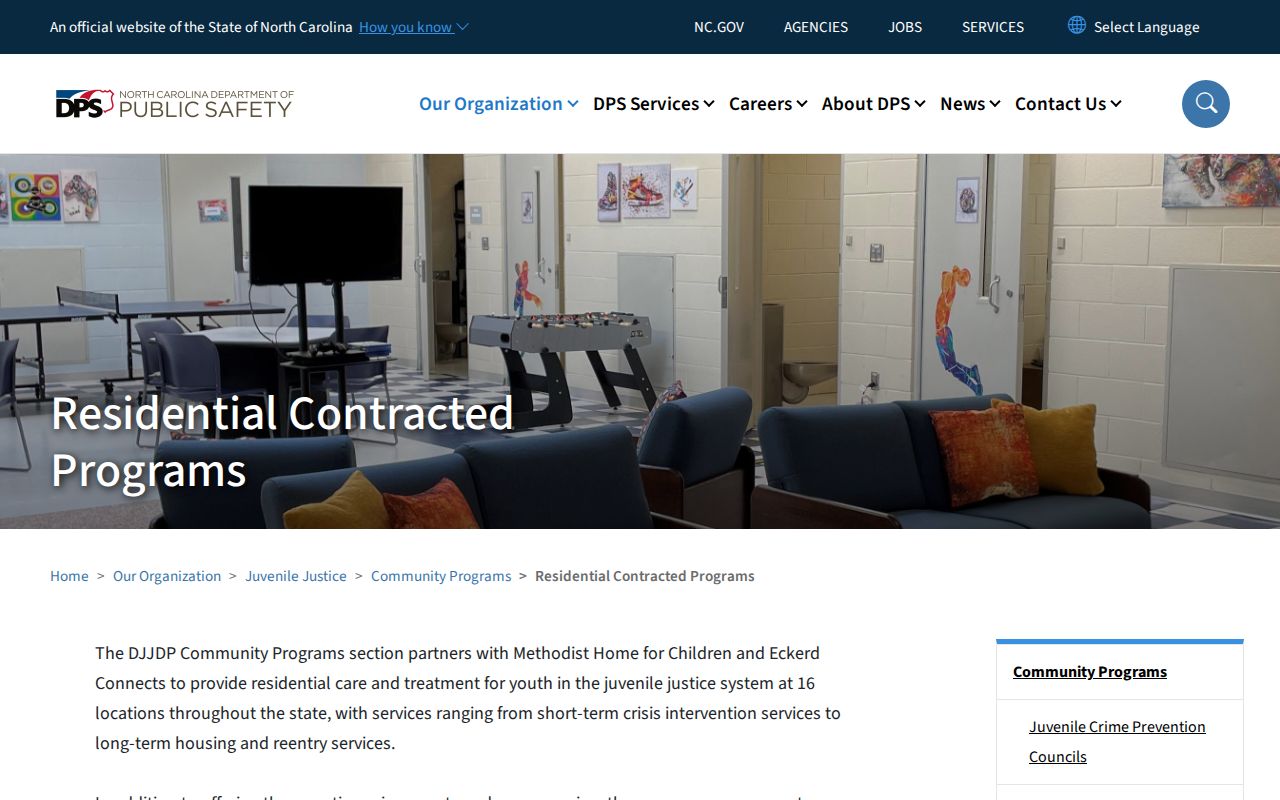
This source helps distinguish a residential service from secure custody. It is not an inmate roster, youth photograph archive, or exit feed.
Hertford Juvenile Exit Confidentiality
North Carolina court access rules restrict juvenile matters. Public adult case tools do not promise access to a youth’s proceeding, placement order, treatment details, or transition plan. A general public-record request cannot be framed as a way around juvenile confidentiality. The lawful route depends on the requester’s role and the court or agency rules that govern that specific case.
Confidentiality also affects photographs. No image of a named participant should appear on a release page, facility list, search result, or program profile. A program-level government screenshot may be used when it contains no youth identity, but it must not be described as proof that someone was placed or released. Likewise, news, social media, and name aggregators are not substitutes for an authorized case source.
The limits serve more than privacy. They also prevent factual errors. An adult with a similar name, a youth in a different program, and a person from the town of Hertford can all be mistaken for a Hertford County participant if location and agency are not checked. The safest public statement stays at the program level.
- Non-secure
- A residential program model that is not the same as secure juvenile detention or an adult jail.
- Court-referred
- Placement is connected to juvenile court and counselor processes rather than adult booking.
- Authorized requester
- A person whose role and identity permit access under the rules governing the youth’s case.
- Program exit
- A case-specific transition under an approved plan, not an adult inmate release-list event.
Hertford Juvenile Exit Context
The Multipurpose Juvenile Home belongs in the Hertford County facility map to prevent confusion, not to expand adult inmate searches. Its local history is tied to a small contracted residential model rather than county detention. The operator, eight-bed design, coed service, and court-referred focus distinguish it from the county jail and from the closed former federal prison at Rivers.
A separate naming trap can misdirect searches. Perquimans Juvenile Detention Center is in the town of Hertford, which is located in Perquimans County. That center is not in Hertford County. The word “Hertford” in a facility name or address must therefore be checked as a county name or town name before any contact or records request is made.
Another distinction is secure custody. Hertford County Multipurpose Juvenile Home is described as non-secure. It should not be labeled a juvenile detention center simply because youth are placed there through a court-related process. Facility type controls both the language and the correct information route.
Note: Confirm the county, operator, and program type before directing an authorized inquiry about a youth’s placement or transition.
Hertford Adult Release Searches Excluded
The Hertford County Sheriff’s detention information line serves the adult county jail. It does not become a public locator for the Multipurpose Juvenile Home. DAC Offender Search covers adult state prison and community-supervision records. BOP Locator covers federal prisoners. ICE ODLS has its own federal scope and does not publicly display people under 18. None should be searched as a proxy for this youth program.
VINELink also must not be treated as a public participant list. North Carolina’s system receives information from participating county jails and DAC, but the research does not identify the Multipurpose Juvenile Home as an adult VINELink contributor. An absent result gives no valid conclusion about a child’s placement. Adult recent-release pages are equally inapplicable.
Even NC Portal is restricted for juvenile matters. A public name search that returns nothing cannot confirm or disprove a youth case. A court order, counselor record, or program communication may exist but remain accessible only through the authorized process. The correct response to a public-data gap is to respect the limit, not infer a secret status.
Safe Hertford Juvenile Records
Public program records and individual case records must remain separate. A public source may name the operator, service model, general age range, capacity, or contract category. It should not connect those facts to a named youth. An individual record may be available to an authorized person, but that access does not make the material fit for public reposting.
When communicating with a counselor or program, share only what the office needs to verify authority and locate the case. Use the secure route provided in case papers. Avoid placing a child’s name, birth date, allegations, placement, or schedule in a public message. If an office asks for written authority, follow its process or consult the youth’s attorney.
A denied public request should not be recast as proof that a record does not exist. It may mean the material is restricted. Ask for a clear explanation of the proper authorized channel, then stop if no legal access applies. No public article, roster, or image gallery can replace that safeguard. General adult release channels are compared on the Hertford County release records home page, but they do not override youth confidentiality.