
Hertford Projected Versus Actual Release
North Carolina’s exact public label is “Projected Release Date.” It is a calculated date based on the sentence record, governing law, credits, sentence relationships, and post-release supervision structure. The date may appear in a DAC incarceration summary and within individual sentence rows. Those values can differ when a person has multiple, concurrent, consolidated, or consecutive terms. Always read the newest period and the record as a whole.
“Actual Release Date” records an event. Inactive incarceration plus an actual date is stronger proof that prison custody ended. An active Probation/Parole/Post Release Status can show that the person then entered community supervision. That does not mean the full sentence ended. A discharge field or official termination record is needed for that broader claim.
| Record label | Meaning | Safe conclusion |
|---|---|---|
| Projected Release Date | A computed estimate under the current sentence data. | The person may leave on that date if no later event changes it. |
| Actual Release Date | The recorded end of a prison custody period. | Prison custody ended for that period, subject to identity and later-custody checks. |
| Active supervision | Probation, parole, or post-release supervision remains open. | The person may be out of prison but still subject to DAC supervision. |
| Discharge | The sentence or supervision phase formally ended. | This is a broader endpoint than release from a facility. |
Find Hertford County Release Dates
Start with the place and legal status. The DAC Offender Search covers North Carolina prisoners, probationers, parolees, and historical state records back to 1972. It expressly excludes local county and city jail records. A short stay only at Hertford County Detention Center may never appear as a DAC incarceration.
- Choose “All” in Offender Status so active supervision is not missed.
- Search by offender number when known, or use name and birth date.
- Match demographics, offense, county, and the most recent record period.
- Read Inmate Status, Incarceration Status, and supervision status before the date fields.
- Compare Projected Release Date across the summary and current sentence rows.
- After the expected day, look for Actual Release Date, inactive incarceration, and release type.
The official form displays the statewide search fields used for this lookup.
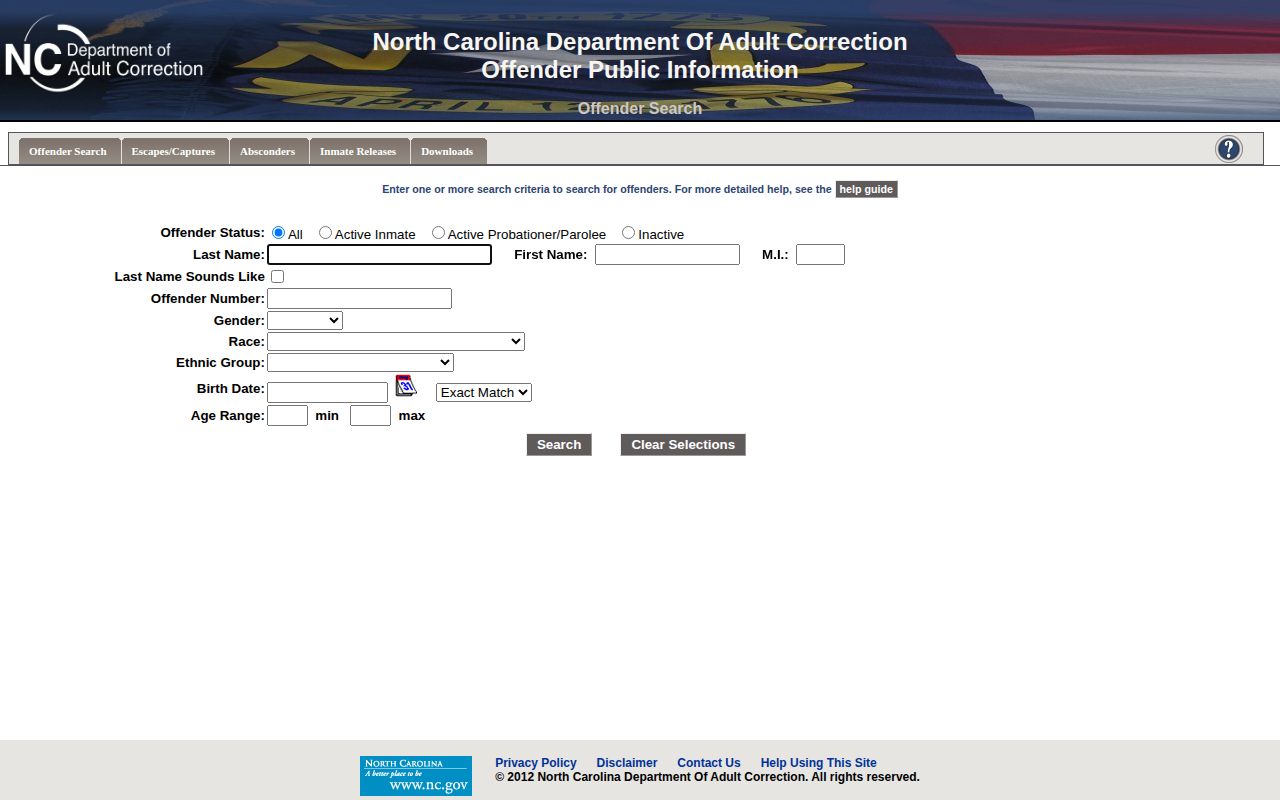
The form can locate a state record, but it should not be used to infer a county-jail date where no DAC term exists.
For a local sentence at the Hertford County Detention Center, call inmate information at (252) 358-7840 and review the Hertford court case. Ask for the sentence, credit, release order, and any locally applied earned time. The Sheriff’s Office is the custodian of jail incarceration records; DAC cannot supply a county-only calculation.
The court judgment explains what term was imposed and whether sentences run together or one after another. It usually does not state the exact hour when jail staff will complete release. Time already served, a later order, another hold, or the custodian’s lawful credit calculation can affect that event. Reconcile the judgment through the Hertford County Courthouse with the current jail or DAC record instead of treating the court entry as a live custody screen.
Note: A pretrial detainee has no fixed sentence-based release date; bond, court action, and other holds control when custody may end.
Hertford Structured Sentence Release Math
For a Structured Sentencing felony, G.S. 15A-1340.13(d) requires service of the active minimum term, subject to a statutory advanced-supervised-release exception. Earned-time credit may move the calculated date from the maximum toward the minimum. It cannot reduce the term below the judicially imposed minimum. DAC has rulemaking authority over how earned time is gained or lost under G.S. 148-13.
For an activated misdemeanor term, G.S. 15A-1340.20(d) permits DAC or the local confinement custodian to award applicable earned time. Combined credit cannot exceed four days per month. The local custodian must apply that rule to a county-jail term. A state-prison formula should not be imposed on a Hertford jail record without the controlling sentence and custodian calculation.
Older Fair Sentencing cases use a different credit framework. DAC describes “gain time,” including good time of one day for one day of good conduct, subject to disciplinary loss, and possible merit time. Offense and sentence dates decide which framework applies. Mixing old good-time language with current Structured Sentencing produces a false release estimate.
No Flat Hertford Release Percentage
North Carolina is often summarized with an “about 85 percent” phrase. That is not a universal rule requiring every person to serve exactly 85 percent of every term. G.S. 15A-1340.17 pairs felony minimum and maximum terms. Some long Class B1 through E maximums use the minimum plus a rounded percentage and added months, while other classes, tables, and reportable offenses differ.
The minimum remains the floor in the standard earned-time calculation. Post-release supervision is also built into the maximum. A sound estimate therefore uses the actual sentence class, minimum, maximum, offense date, credit record, sentence relationship, and supervision law. A slogan cannot replace those fields.
The DAC earned-time explanation notes that current Structured Sentencing offenders assigned to qualifying work or full-time programs may earn time from the maximum toward the minimum. Assignment, completion, discipline, and sentence changes can alter the calculation. No one should promise an exact date from the judgment alone.
This distinction also prevents a common error with older cases. Fair Sentencing gain time and current earned time are not interchangeable labels for the same formula. Offense date, conviction date, sentence class, and the specific credit record identify the governing method. Where a public detail contains more than one projected date, ask DAC which current sentence combination controls rather than selecting the earliest figure.
Hertford Release to Supervision
Release from prison may begin the supervised part of the same sentence. Under G.S. 15A-1368.2, the general prison-release calculation for Class B1 through E terms is the maximum less 12 months and earned time. For Class F through I terms, it is the maximum less nine months and earned time. Certain reportable convictions use a 60-month supervision subtraction plus earned time. Statutory details and sentence facts control.
The supervision terms are generally 12 or nine months for the corresponding groups, while qualifying registration offenses commonly carry five years. A person cannot refuse post-release supervision. Thus “released from prison” can coexist with an active DAC status, conditions, and a future supervision end date.
The official statute page shows the sentence-specific post-release calculation.
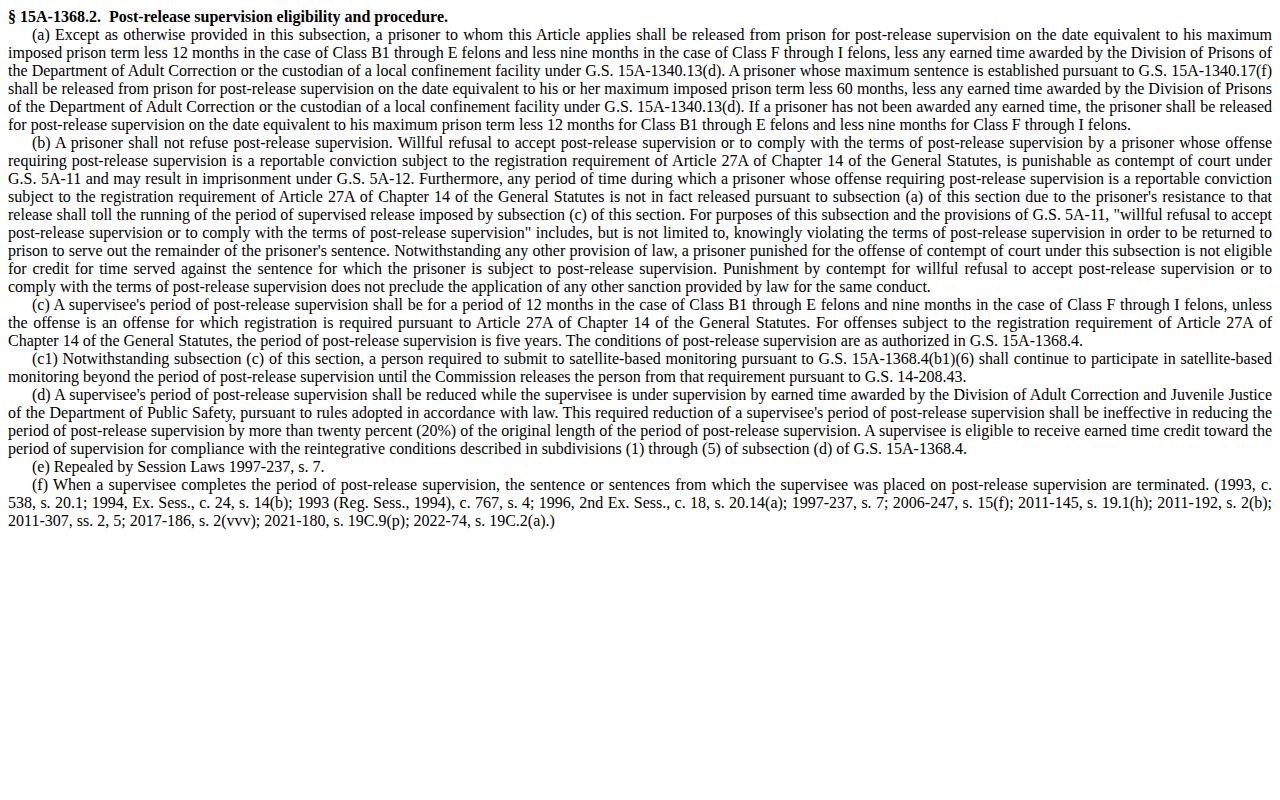
The law explains why a prison exit date and full sentence discharge are separate milestones.
Why Hertford Release Dates Change
A forecast changes when the facts used to compute it change. DAC specifically identifies transfers, discipline, assignment to or removal from work and programs, resentencing, vacated sentences, and changes in law or controlling cases. Multiple sentence rows also matter. A new consecutive term can move the endpoint, while a corrected credit award may move it closer.
| Change | Possible effect | Where to verify |
|---|---|---|
| Earned time gained | Moves the projection from the maximum toward the statutory minimum. | Current DAC sentence record or local custodian for a jail term. |
| Discipline or forfeiture | May remove credit and move the projected date later. | DAC or the confinement custodian. |
| Program assignment or removal | May alter the rate or availability of earned time. | Current DAC calculation. |
| Resentencing or vacated term | Changes the legal basis of the computation. | Court order joined to an updated custody record. |
| Concurrent or consecutive terms | Changes how separate sentences combine. | Judgment and current sentence rows. |
| Detainer or new custody | May prevent community release even when one agency’s term ends. | Receiving agency and transfer record. |
A parole approval also does not prove physical release. The Commission’s public result should be followed by a DAC Actual Release Date and inactive incarceration status. Similarly, a county-jail departure may be a transfer to DAC, federal custody, ICE, or another jail. The receiving system decides the next status.
Confirm Hertford Actual Release Dates
Check again after the projected day. For a state prisoner, open the newest DAC period and read Actual Release Date, Incarceration Status, release type, current or previous location, and supervision status. The separate DAC Inmate Releases Search can discover prison releases from the current and prior two calendar years. It searches by release county, year, and month or surname, and it is not a Hertford County jail feed.
For county custody, request the entry and release summary or release order from the Sheriff and reconcile it with the court file. Ask whether the exit was community release or transfer. State Archives rules allow destruction of inmate-incarceration records three years after release or transfer, subject to holds, so a narrow older request should be made promptly.
NC SAVAN/VINELink may alert on a participating agency’s release or transfer. A “released” result confirms departure from the reporting contributor, not freedom from all custody. The VINELink Check can help monitor an expected event, while documentary confirmation still comes from DAC, the Sheriff, the court, or a receiving agency.
Federal and immigration systems form separate boundaries. A federal projected date belongs in the BOP Inmate Locator and may change after federal recalculation. An ICE or U.S. Marshals transfer is not shown as a Hertford or DAC community release. If a jail record names another custodian, continue with that agency and preserve the transfer wording. One system’s end date cannot rule out custody in another.
Identity and timing both matter. An old actual date can be accurate even if the person has since returned to custody on another matter. Record the custody period, actual date, release type, and the date the source was checked. A narrow statement such as “released from DAC custody on the recorded date” is more reliable than a claim about present freedom.